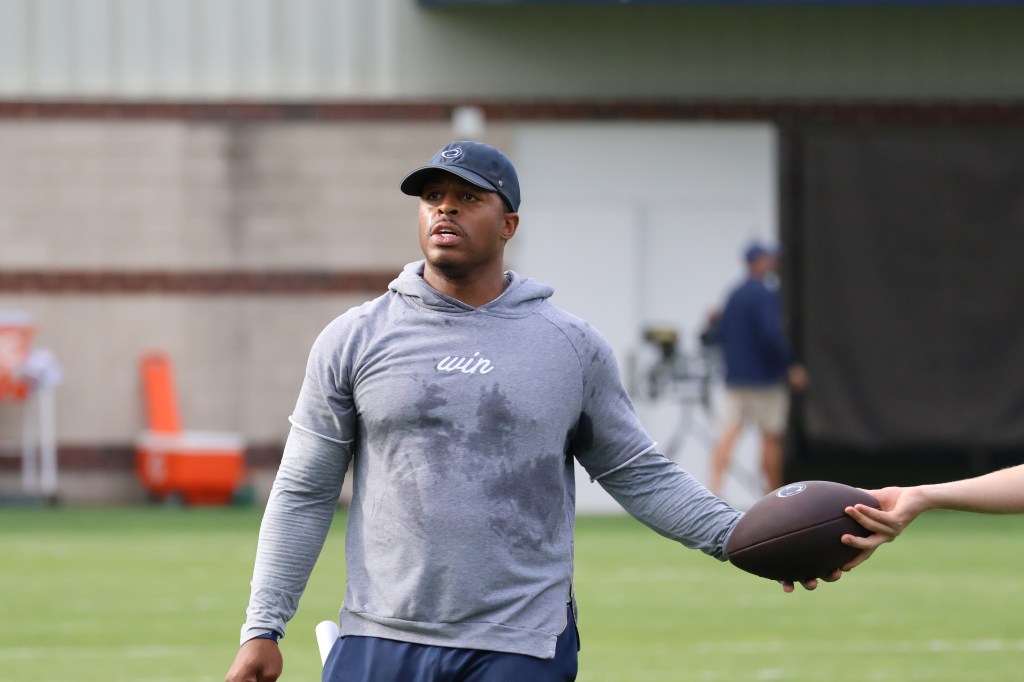
The performance of Penn State’s wide receivers over the past two seasons has been a hot topic among fans and analysts, with many calling for changes within the coaching staff. Marques Hagans, Penn State’s wide receivers coach, has faced significant criticism, but is it fair to place the blame solely on him? Here are three reasons why Hagans deserves more time to prove himself.
1. Inheriting a difficult situation
Hagans stepped into a challenging role following the departure of Taylor Stubblefield. Penn State’s wide receiver room lacked depth and consistent production even before Hagans arrived. Stubblefield struggled in recruiting and failed to establish a solid foundation in the transfer portal. When Hagans was brought in, he faced an uphill battle to rebuild the room while competing against elite programs like Ohio State and LSU, which are widely known for developing NFL-caliber wide receivers.
Moreover, Penn State’s offensive scheme under both Mike Yurcich and Andy Kotelnicki has not prioritized wide receivers. The offense is built around a balanced attack, but its focal point has been the ground game and the tight end position, as seen in Tyler Warren’s breakout season in 2024. Asking Hagans to completely revamp the wide receiver room under these conditions is a tall order.
2. Signs of progress amid challenges
Despite the adversity, there are indications of progress. In 2024, Penn State’s wide receiver group, led by Trey Wallace and Julian Fleming, showed improvement in blocking and complementary roles, even if the production didn’t leap off the stat sheet. Wallace, for instance, finished the season with 46 receptions for 720 yards and four touchdowns—a modest improvement over his predecessors.
Additionally, Hagans’ recruiting efforts have been a bright spot. The 2024 class included promising talents like Tyseer Denmark, while the 2025 group boasts four four-star commitments, including Matthew Outten and Kobe Howard. These recruiting wins suggest that Hagans is capable of building a pipeline of talent despite Penn State’s reputation as a program that prioritizes running backs and tight ends over wide receivers.
3. Continuity is crucial
In the midst of Penn State’s search for a new defensive coordinator, the last thing the program needs is more instability. Constant turnover among position coaches disrupts development and hinders recruiting. Allowing Hagans more time to implement his vision and develop his recruits could pay dividends down the road.
Looking ahead to 2025
The additions of USC transfer Kyron Hudson and Devonte Ross are expected to bolster the wide receiver room in 2025. Hudson, a physical blocker, and Ross, a speedy slot receiver, will bring new dimensions to the offense. Combined with continued growth from younger players like Denmark and the emergence of tight ends Khalil Dinkins and Luke Reynolds, the offense appears well-equipped to complement Penn State’s dominant ground game led by Nicholas Singleton and Kaytron Allen.
Final Thoughts
While the wide receiver room’s lack of production in marquee games has been frustrating, it’s important to consider the broader context. Hagans inherited a challenging situation, and the offensive scheme doesn’t lend itself to prolific wide receiver stats. Nevertheless, he has shown progress in recruiting and player development. Patience and continuity could be the key to unlocking the full potential of Penn State’s wide receivers.
What do you think? Should Marques Hagans be given more time, or is it time for a change? Let us know in the comments below.
 Zach Seyko Sports
Leave a comment